Personalizing Patient Pay
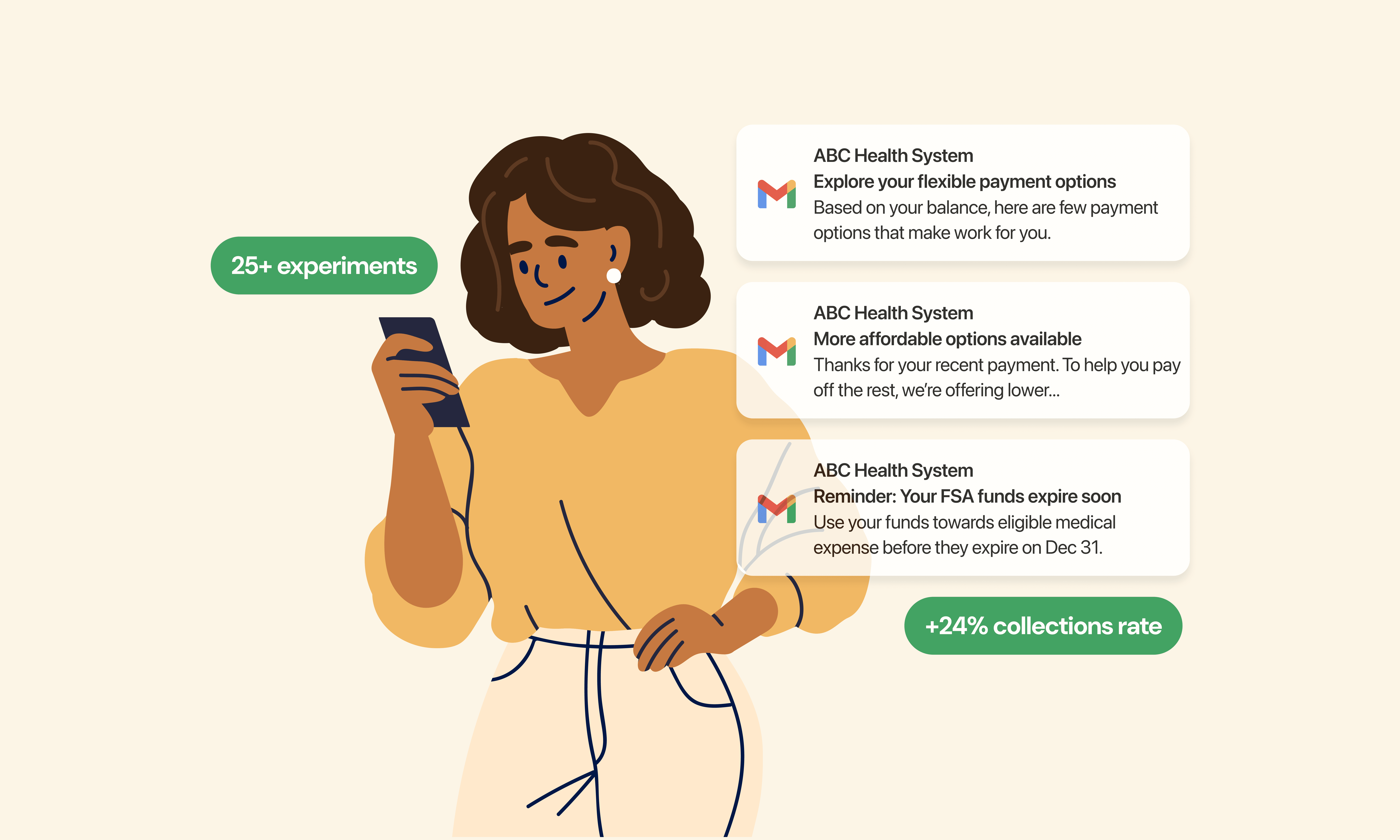
Led a personalization program across 12 health systems, matching the payment experience to each patient's financial situation. Ran 18+ A/B tests across the funnel, projecting +1.66% collections lift.
Client
Cedar
Type
Cedar
Year
2026

Process
Scaling a proven model
The Code Yellow experiments showed that personalized communications moved collections for one client. Scaling that across 12 health systems meant figuring out what translated universally and what needed to flex per client. That was the harder design problem.
Validating the personalization strategy
I led a team of 3 designers to run 18+ A/B tests across the payment funnel, organized around two tracks: convenience for small balances, and affordability for large ones. Each experiment had a clear hypothesis and a shared metric: collections rate.
Adapting to client constraints
Scaling exposed new complexity. The flexible payment options email performed well across most clients but underperformed for one. Digging in, I found their limited payment plan rules were the root cause. This led to documented payment plan guardrails and a client sensitivity framework so the team could design with confidence across different health system constraints.
Getting closer to patients
I ran a workshop with clients to pressure test our cohort assumptions. We'd started with broad segments like balance size and insurance status. The workshop surfaced more nuanced profile. For example, our clinician staffer clients experience trust issues with patients that comms weren't currently addressing.
Building toward designer-led programs
I'm now leading the clinician staffer initiative end-to-end, no PM. It's an experiment in how designers can operate at Cedar to adapt to the changing tech industry.


Outcome
By the end of our first quarter, we ran 8+ A/B tests across the funnel, projecting +1.66% collections lift.